Friday, March 29, 2019

Ephemera: Writings of the Past


ephemera:  (singular: ephemeron) any transitory written or printed matter not meant to be retained or preserved, paper items (such as posters, postcards, and tickets) that were originally meant to be discarded after use

  There's something amazing about reading the personal writings of someone from 100 years ago.  When I first decided to add some vintage postcards to my antique collections, I only bought them for the beautiful art and design work.  Even though they were mass produced, they still had a unique look to them.  It was only after I took the time to read the correspondence did I start to appreciate the writing as well as the art.

  Here are the postcards and their writings that I have collected so far, all from the early 1900s.  I have copied them as closely as they are written, but included missing letters from words caused by presumably poor literacy and grammar, and question marks when I had trouble reading the handwriting:

A Wise Old Owl

 
No postmark(never mailed, or mailed in an envelope)
Mr. Wray
Norman, OKL
August 4, 1910
Dear cousin Wray:
I will write you a line or two.  Is the corn gone there.  How is the calf. Love to all Ruth


Best Wishes From ’Mildred’ (written in pencil)

Posted(date worn and unreadable)
Miss Ester Petsch
Hollenberg, Kansas
Dear Ester,
I will drop you a line we are all well at present.  Bethel is a sleep now I am looking for you down soon.
Your Friend
Mildred Lockhart


Best Wishes

Posted Oct 26, 1909
Miss Myrtle Runt
Irwin Pa.
Westmorland, Co.(?)
Oct. 23 1909
Dear Cousin
I wrote to you last and did not get answer yet I though(t) may be Grandmother is sick answere I will be waiting.
Mazie


A Friendly Greeting

Posted Oct 28 1911
Mis(s) W. H. Williams
Vandergrift Hts PA #374
Margaret will not be over as Mr. Toylov(?) is not expected to live over today and she says that she will ove(r) some of these days soon.
Rels


No postmark(never mailed, or mailed in an envelope)
Miss L Gillam
Sandy Oregon
of Ed Gillam
Portland
May 12, (19)09
My dear little neice
I have sent you the goods to mak(e) you dresses.  I hope you will like them.  dont forget auntie and come and see me when you can. love to all, Mrs J E Wingate
225 ½(?) Mill St


  I'm not sure if I'll add to this relatively small collection, but either way I'm glad I had the chance to rescue these pieces of art and history from their probable fate of the landfill.


For more information:
The Ephemera Society of America
The Ephemera Society(UK)

Friday, March 15, 2019

The Lost Practice of Mourning Etiquette


  I am no stranger to death. I've lost my maternal grandparents, my father, a couple friends, and at the end of this past November, by mother. Her passing has made me think a lot about death and how to deal with such an unpredictable event and move forward with life. It seems in this modern world that we are meant to accept what has happened and to learn to continue with life as usual without having much time to grieve. In previous centuries, the death of a loved one was taken very seriously, and the bereaved weren't expected to move on within a week, or even a month. Along with this consideration, there were a myriad of rules and etiquette to follow to not only notify others to one's loss, but as a symbolic movement through the stages of grief to eventually allow one to return to normal life.


  It is still common practice to wear all black to a funeral, but in the 19th and early 20th centuries(and some centuries before that), the wearing of black was practically mandatory until the bereavement period was over. I have a book from 1895 titled 'Parlor Amusements and Social Etiquette', compiled by G.H Sandison and published by the Christian Herald, New York. Within there are a few pages dedicated to the mourning etiquette of the period:

"MOURNING ETIQUETTE

Death comes to all alike and custom has long established a conventional observance in dealing with the presence of death, in our own homes or elsewhere. In our own country black is worn as the typical attire of sorrow, and it has come to be regarded as a token of respect to the lost one. It is now decreed that crape shall only be worn six months, even for the nearest relative, and that the duration of mourning shall not exceed a year. A wife's mourning for her husband is the most conventionally deep mourning allowed. Bombazine and crape, a widow's cap, and a long, thick veil-- such is the modern English idea. Some widows even have the cap made of black crepe lisse, but it is generally of white. In this country a widow's first mourning dresses are covered almost entirely with crape. There are now, however, other and pleasanter fabrics which also bear the dead black, lustreless look which is alone considered respectful to the dead, and which are not so costly as crape or so disagreeable to wear. The Henriette cloth and imperial serges are chosen for heavy winter dresses, while for those of less weight are tamise cloth, Bayonnaise, grenadine, nuns' veiling, and the American silk.

Mourning is expensive, and often costs a family most than they can well afford; but it is a sacrifice that all gladly make. Many consider it an act of disrespect to the memory of the dead if the living are not clad in gloomy black.

Widows wear deep mourning, consisting of woolen stuffs and crape, for about two years, and sometimes by choice for life. Children wear the same for parents for one year, and then lighten it with black silk, trimmed with crape. Half mourning gradations of gray, purple, or lilac have been abandoned, and, instead, combinations of black and white are used. Complimentary mourning is black silk without crape. The French have three grades of mourning-- deep, ordinary, and half mourning. In deep mourning, woolen cloths only are worn; in ordinary mourning, silk and woolen; in half mourning, gray and violet. In France, etiquette prescribes mourning for a husband--six months of deep mourning, six of ordinary, and six weeks of half mourning. For a wife, a father, or a mother, six months--three deep and three half mourning; for a grandparent, two months and a half of slight mourning; for a brother or a sister, two months, one of which is in deep mourning; for an uncle or an aunt, three weeks of ordinary black. Here, ladies have been known to go into deepest mourning for their own relatives or those of their husbands, or for people, perhaps, whom they have never seen, and have remained for seven or ten years, constantly in black; then, on losing a child or a relative dearly loved, they have no extremity of dress left to express the real grief. Complimentary mourning should be limited to two or three weeks.

The duration of a mourner's retirement from the world has been much shortened of late. For one year no formal visiting is undertaken, nor any gayety. Black is often worn for a husband or wife two years, for parents one year, and for brothers and sisters one year; a heavy black is lightened after that period. Ladies are beginning to wear a small black gauze veil over the face, and are in the habit of throwing the heavy crape veil back over the hate. It is also proper to wear a quiet black dress when going to a funeral, although not absolutely necessary. Friends may call on the bereaved family within a month, no expecting, of course to see them. Kind notes expressing sympathy are welcome from intimate friends; and flower, or any similar testimonial of sympathy, are thoughtful and appropriate.

Cards and note-paper are put in mourning, but very broad borders of black are in bad taste. A narrow border of black is correct. The use of handkerchiefs with a two-inch square of white cambric and a four-inch border of black is to be deprecated.

Mourning which soldiers, sailors, and couriers wear is pathetic and effective. A flag draped with crape, a gray cadet-sleeve with a black band, or a piece of crape about the left arm of a senator, a black weed on a hat, are in proper taste.

For light mourning, jet is used on silk, and makes a handsome dress.

Elegant dresses are made with jet embroidery on soft French crape, but lace is never "mourning." During half mourning, however, black lace may be work on white silk; but this is questionable. Diamond ornaments set in black enamel are allowed even in the deepest mourning, and also pearls set in black. Gold is never worn in mourning.

The Swedish kid glove is now much more in use for mourning, and the silk glove is made with such neatness and with such a number of buttons that it is equally stylish, and mush cooler and more agreeable. Mourning bonnets are worn rather larger than ordinary bonnets.

People of sense, of course, manage to dress without going to extremities in either direction. Exaggeration is to be deprecated in mourning as in everything. The discarding of mourning be effected by slow stages. It shocks persons of good taste to see a widow changed into colors hurriedly. if black is to be dispensed with, let its retirement be slowly and gracefully marked by quiet costumes, as the grief, yielding to time, is giving way to resignation and cheerfulness.

Before a funeral the ladies of a family see no one but the most intimate friends. The gentlemen, of course, see the clergyman and officials who manage the ceremony. It is now the almost universal practice to carry the remains to a church, where the friends of the family can pay the last tribute of respect without crowing into a private house. Pall-bearers are invited by note, and assemble at the house. They, accompanying the remains, after the ceremonies at the church, to their final resting-place. The nearest lady friends seldom go to the church or to the grave. This is, however, entirely a matter of feeling, and they can go if they with. After the funeral only the members of the family return to the house. It is not expected that a bereaved wife or mother will see any one other than the member of her family for several weeks.

All the preparations for a funeral in the house are committed to the care of an undertaker, who removes the furniture from the drawing-room, filling all the space possible with camp-stools. The clergyman reads the service at the head of the coffin, the relatives being grouped around. The body, if not disfigured by disease, is often dressed in the clothes worn in life, and laid in an open casket, as if reposing on a sofa, and all friends are asked to take a last look. The body of a man is usually dressed in black.

The custom of decorating the coffin with flowers is beautiful, but has been overdone, and now the request is frequently made that no flowers be sent. No one in mourning for a parent, child, brother, or husband, is expected to be seen at a concert, a dinner, a party, or at any other place of public amusement, before three months have passed. After that one may be seen at a concert. But to go to the opera, or a dinner, or a party, before six months have elapsed, is considered heartless and disrespectful. If one choose, as some do, to wear no mourning, then he can go, unchallenged, to any place of amusement, but if he put on mourning he must respect its etiquette.

A woman may wear mourning all her life if she choose, but it is a question where in so doing she does not injure the welfare and happiness of the living."

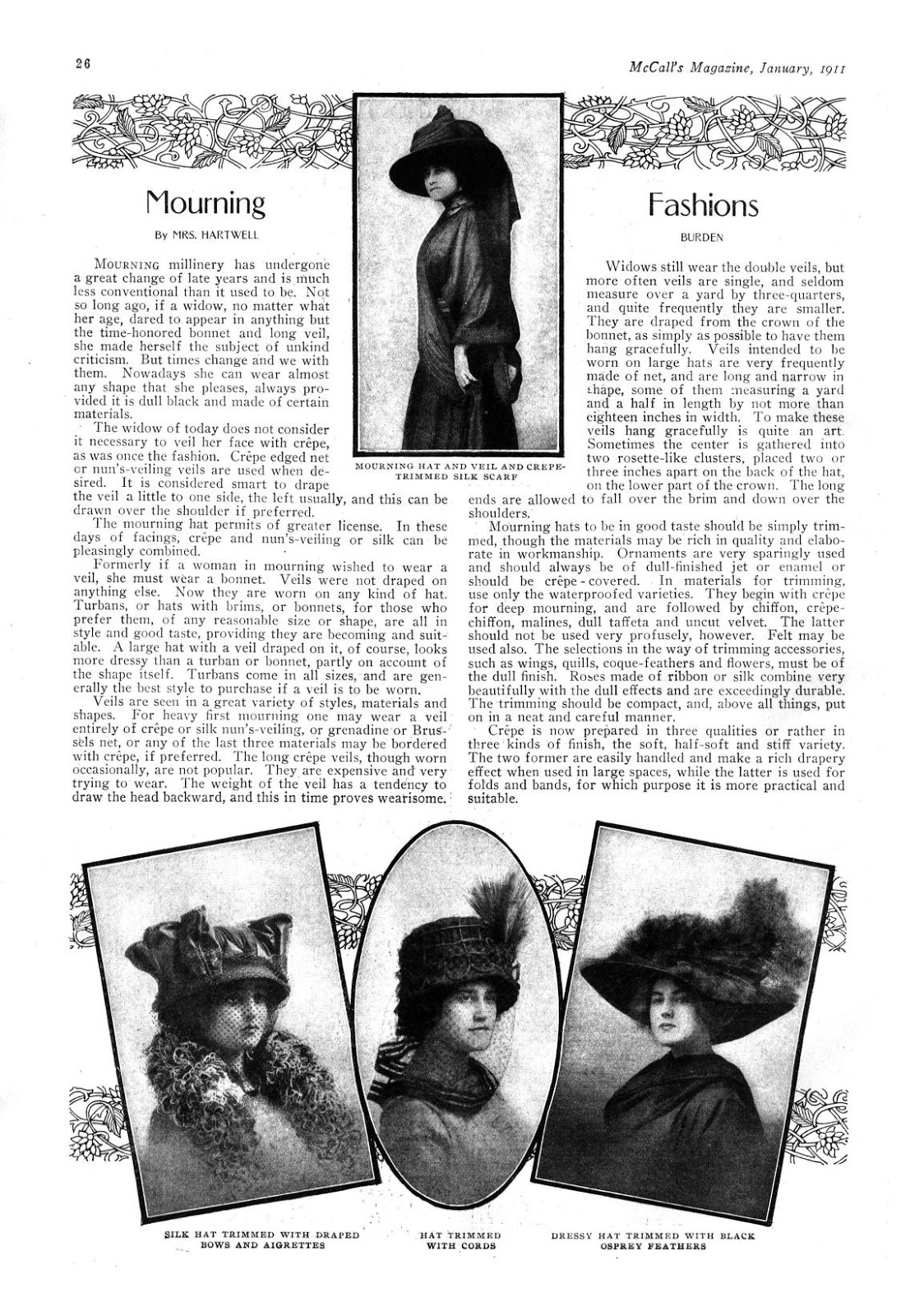
And here is an article from McCall's Magazine, January 1911 on the current mourning fashions:


  As mentioned in both the book and the article, jet was the preferred material for jewelry and accessories. Jet is a fossilized wood from an ancestor of the Monkey Puzzle tree(Araucaria araucana), known for its opaque black color, coining the term 'jet black'. It is sometimes called 'Whitby Jet' because large quantities are found in and near Whitby, England. Jet became predominant in mourning fashion when Queen Victoria started to wear it during the mourning of her husband Prince Albert in 1861, which lasted the rest of her life. Jet can be left in a duller state or polished to a shine, which was appropriate for stages of mourning that called for both finishes. Since true jet is somewhat rare and more expensive, there were numerous imitations, including French jet, which is black glass produced mostly in France, along with onyx, obsidian, and vulcanite/ebonite.

  In my antiquing adventures I've seen my share of mourning pieces, including jet jewelry and black crepe clothing, but I've only added a few pieces to my collection that may have been used for mourning.


Circa 1900 bar pin, shown in more detail in this post, is of a dull black material with seed pearls within. I hadn't thought this was for mourning until reading the book quoted above, which states: "Diamond ornaments set in black enamel are allowed even in the deepest mourning, and also pearls set in black."


Circa 1900 buttons, made of black glass which I can assume is French jet.


Circa late 1800s brooch, my only sure example of jet, from England.


"One precious to our hearts has gone
The voice we loved is stilled,
The place made vacant in our home
Can never more be filled..."


Resources and Further Research:
Art of Mourning - A resource for memorial, mourning, sentimental jewelry and art
Identifying Black Materials Used in Victorian Jewelry

Friday, January 11, 2019

Decorative Hair Combs and the dreaded Celluloid Rot


  A sure way to look like a lady from another time is the use of a decorative hair comb. These pieces of art have been mostly gone in fashion, but were widely used in hairstyles until around the 1910s and 1920s. Watchers of period dramas like Downton Abbey will most likely have seen these accessories in action.

Mary Crawley with a hair comb peeking from the right side.

  Early examples were made of anything from ivory to tortoiseshell to various metals, and were not only decorative as the title suggests, but did help to hold a lady's hair in place. The invention of plastics, like celluloid and galaith, reached the hair comb industry and boomed, especially since they could be carved and molded which made them perfect(and cheaper) substitutes for ivory and tortoiseshell.

As the hair was worn high on the head at this time, so was the comb, reminiscent of a crown.

Late Victorian 'coiffures and combs'.

Catalog mentioning imitations for natural materials.

Beautiful and unique comb with a 1920s coiffure.

Fingerwaves and comb.

Auguste Bonaz advertisement, a prominent maker of hair combs in the 1910s and 1920s.

  Since I've been learning how to incorporate older fashions into my everyday life, I couldn't help but try to add some hair combs into my collection. They can be surprisingly hard to find in antique stores, I suppose since they've been out of fashion for so long, and are usually a pretty penny. However, I've been lucky enough to find three pieces in magnificent shape, and one that, sadly, has succumbed to celluloid rot.


Spanish mantilla style, faux tortoiseshell, not sure if celluloid or galaith, carved.


Black celluloid, faceted black gems(probably same material) attached.


Black celluloid, my favorite piece.


Amber and black celluloid, showing signs of rot on the amber part.

  What is celluloid rot? Most might not think that plastic would degrade within a hundred years, but old celluloid is different. The chemicals were not as stable as plastics nowadays, and can start to decompose. There are a variety of conditions that can cause celluloid rot(temperature, humidity, sun exposure, and lack of oxygen), and once it has started there's no fixing it, and worse still, it has been known to spread to other pieces if in close quarters. Being new to collecting celluloid, I didn't know what the rot looked like until I bought a comb that was surprisingly cheap. I should have known there was a reason for the low price on this large and gorgeously carved piece, but I just thought I could clean it up and all would be fine.


What I had thought were just cracks are actually a common sign of the camphor molecules in celluloid being released - a sure indicator of celluloid rot.

  After some research into how to clean celluloid, I stumbled upon some photographs of what celluloid rot actually looked like, and I was saddened to see the same damage on my lovely new acquisition.


More signs of decomposition - bubbling and rough textures. Celluloid rot is more common in lighter colored celluloid, most likely because there are less fillers which makes the celluloid less stable. I've never seen examples of rot on black celluloid, but that doesn't mean it isn't possible.

  Luckily I hadn't had it long enough to put it with my other combs, and immediately boxed it up in cardboard(something to let air get to it so as to not exacerbate the problem) and moved it as far from my combs and all other celluloid as possible. I now know better and thoroughly inspect any piece of celluloid before I buy it for this damage, but I don't let this mistake discourage me from continuing to add to my ever-growing celluloid collection.

Friday, December 21, 2018

Restoring a 1920s Djer-Kiss Rouge Compact


   As someone who is trying to live a vintage style life, I like to incorporate vintage items into my life whenever I can. I love to collect vintage and antique makeup products and compacts, but I know better than to actually use these products. Not only have they been used and are incredibly expired, but who knows what sort of ingredients were considered 'safe' back when these products were first created. That being said, I also hate to remove the old makeup when it's in fairly good condition, not just for value's sake, but also to be able to see the original colors that were used at the time. However, I don't feel so bad about restoring items that are either in pretty rough shape already, have a cheap price tag, or even better, are lacking their original makeup which is what drives up their value. I was lucky enough to come across the most perfect item to start me on this mission - an empty 1920s Djer-Kiss rouge compact.


  Djer-Kiss(pronounced 'deer-kiss') was a perfume company that delved into cosmetics(as many companies did when makeup became socially acceptable), running from around 1903 until the 1960s. They are famously known for their 'Kissing Fairies' line, including a very Art Nouveau style compact that is quite valuable.

I certainly don't have the deep pockets for such a beautiful piece, and I definitely wouldn't want to ruin its value by restoring it either!


  The idea for this restoration was sort of an accident. I had bought a talc-free Physician's Formula blush a while ago which had sadly been moved around too many times and the powder inside just crumbled to pieces.

My poor destroyed Physician's Formula blush in 'Natural'.

  It has drifted around my home while I tried to figure out what to do with it, until I thought it's in the perfect state to be put into a different case. I tossed around the idea of just finding a photograph of an old rouge label and putting that on a new container, since most old compacts are too expensive to be messed with. In my research for simply a picture I found this compact. It's like it was meant to be - cheap, antique, without any makeup - just waiting for me to bring it back to life.


Condition of compact upon purchase. Wear scratches on the outside, sticker on bottom still intact, some powder floating around the inside, mirror complete, overall great shape for a makeup item from the 1920s!

The Supplies:


  First I cleaned the compact with q-tips and a little water, being thorough but not too harsh, and making absolutely sure not to get any water in the space behind the mirror. This can loosen the glue and make the mirror shift, which can ultimately lead to breakage.

All cleaned up!

  I then took the powder and mixed it with just enough isopropyl alcohol to make a slightly wetter toothpaste consistency(this is a common method of re-pressing powder cosmetics, and there are endless tutorials online. Note that the texture may change a bit, but seeing as this is blush and not eyeshadow where the texture is everything, I'm not too concerned*).

Before the alcohol.

After adding the alcohol.

  This paste I carefully put into the compact; a spoon was perfect for this job.

I was surprised to find that all the powder fit inside this tiny compact, the difference in size can be seen in the photograph. Just goes to show how much unnecessary packaging is used in cosmetics these days!

  Once the blush-paste was put inside the compact, I simply cleaned up the edges and let it sit out to dry for a few days.

Not the prettiest, but it'll work!

  And here it is! My very own 1920s blush, as if I stepped back in time and bought it from the local department store.


*The texture did change, it's harder than it was previously but not unusable.  I would, and may, do this again.


For more information on Djer-Kiss company and products:
The History of Djer-Kiss