Friday, June 21, 2019

For The Love Of Vintage Plastics: My Celluloid Collection

   My celluloid collection has been, almost accidentally, steadily growing since I started collecting antiques.  It turned out many of the items I wanted to buy were made from celluloid, which heightened my interest in learning about this plastic.

  As I had mentioned in my post about celluloid, I first became interested in collecting this plastic through searching for decorative hair combs.  Most hair combs from the 1910s-1930s are made from celluloid, so my love of combs inadvertently started my love of celluloid.

Decorative hair combs, circa 1910s-1920s. 
(There's a possibility the tortoiseshell comb is galaith, but with no markings I suppose I'll never know.)

  I then became intrigued by the beautiful dresser sets of the 1920s-1930s, many of which were made of a mother of pearl-like celluloid.  This type continues to be my favorite form of the plastic, and I struggle with having the will power to not purchase all of it.

 My pieced together, almost matching, dresser/toilet set in Maize Pearl with black edging, circa 1920s-1930s.

Button hook and cuticle cutter are from the same set, unmarked.

Mirror from a different set, unmarked.

Brush from a different set, marked 'DuPont USA'.


Shoe horn, circa 1920s.  A different pattern of pearl, marked 'Hampton Arch Amerith'.


Comb marked 'Lady Bobbie Trade~Mark' in Maize Pearl with rainbow swirl edging, circa 1920s-1930s.  While cleaning I broke off two of the teeth.  I managed to super-glue them back on, but I won't be able to use it now for fear of further damage.  Take it from me - be gentle with vintage plastics!


 Fold-up mirror in White Pearl, circa 1950s.  Marked 'Japan'.

  The rest of the pieces I've acquired are of the French Ivory/Ivorine/Pyralin style. 

Another dresser/toilet set, more specifically a manicure set, all matching, circa 1920s-1930s.  The close ups of the handles visibly show the faux striations to mimic true ivory.


Floral brooch, circa 1930s-1950s.  Not the usual French Ivory type, has no lines and light blushes of paint on the flowers.


Glove stretcher, marked 'French Ivory', 'Made in England', circa 1900-1910.  This is the only celluloid piece I bought not because it was celluloid, since at the time I thought French Ivory meant actual ivory.

My current whole collection.


Friday, May 31, 2019

Hair Receivers and Making My Own Hair Rat


While wandering through an antique store, one might come across something that looks like this:


And a thought might cross the mind, "Oh, what a beautiful trinket/powder jar!"  Unfortunately, that thought would be wrong.  This is a hair receiver, a specially made container for storing ones own hair.  Nowadays this might seem like a strange concept, but with more women becoming interested in Edwardian/Gibson girl hairstyles, I feel that a revival in hair receivers is in order.


The most common hair receivers I find are these celluloid ones.

  For hundreds of years, women(and men) used human hair in their hair pieces.  This hair was used in pieces that were added for volume('hair rolls' and 'puffs') and length('switches' and 'braids'), as well as in the wig industry, not unlike false hair pieces that can be purchased now.  Aside from the pieces that were purchased, women would collect their own hair for use in making hair 'rats' or 'ratts'.  These 'rats' were used to add volume for the elaborate hairstyles of the Victorian era, as well as for achieving that pompadour or Gibson girl look during the turn of the 20th century.  They were also used throughout the next few decades for making rolls on the lower back of the head as well as any other area more volume was wanted.

Sears & Roebuck Co. catalog from 1912 showing human hair rolls as well as mohair ones, the commercial equivalent of homemade hair rats.

Another example from a Montgomery Ward catalog from 1916 showing hair rolls made from wool.

And finally, another Sears & Roebuck Co. catalog from 1922 showing human hair rolls as well as wool ones.

  During my antiquing adventures I've come across quite a few hair receivers and admittedly was clueless as to their usage until one was very clearly marked 'hair receiver'.  It was then that it clicked - and my desire to acquire all things vintage living told me that I must buy and use one of these.  So after seeing the usual celluloid ones time and time again, I found one that was unique from the rest and a very good price(hair receivers range in price from $5-$30 depending on whether they are made from cheaper plastics like lucite and celluloid or porcelain and metal with glass).

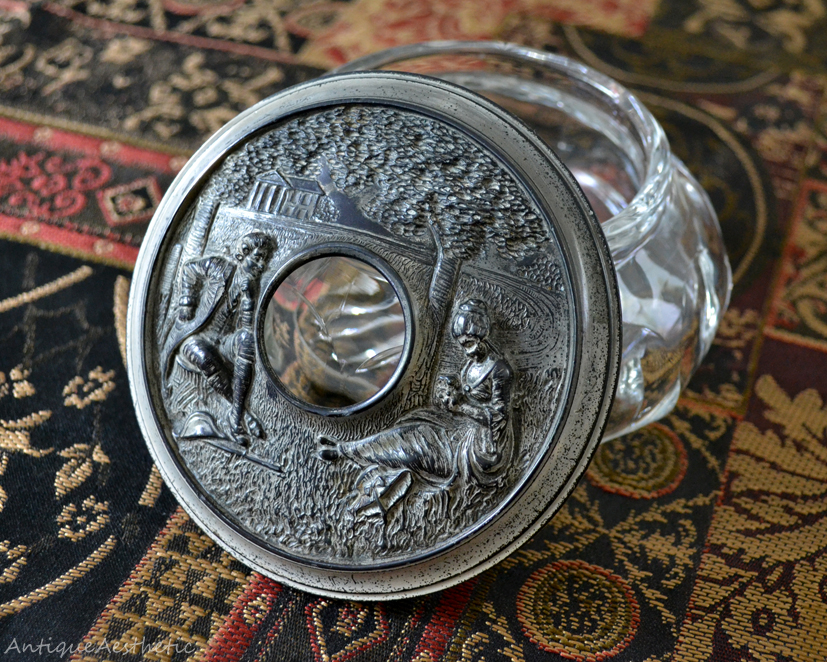
My hair receiver - made of glass and some sort of metal, with an 18th century scene depicted on the lid.

  Now comes the part which requires a lot of patience - collecting the hair.  This depends on several factors: the length of the hair, how often it is brushed, how much the hair naturally sheds when brushed, and just how big the hair rat is to be.  I have long, thick hair and I've been collecting for about a year now.  Note that I don't save hair when I travel(which is fairly often), only what is collected in my brush while I'm home.

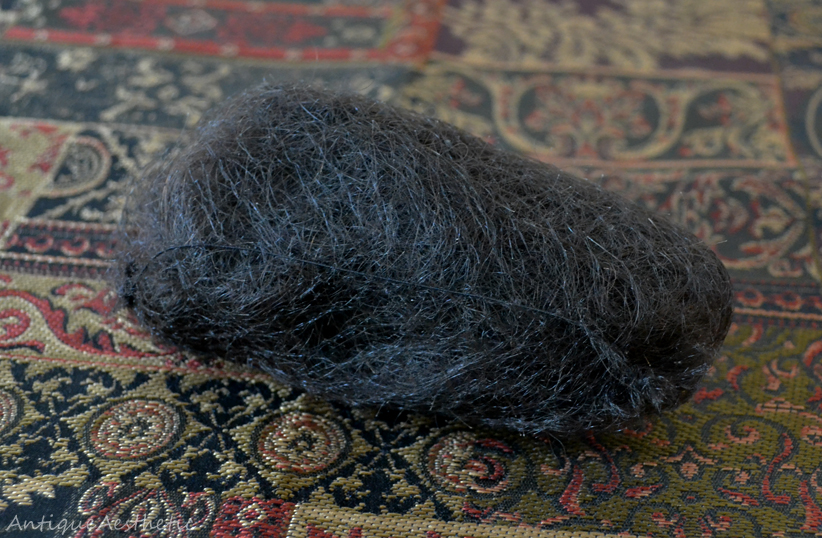
What I've saved to this point.

  From what I have, I've decided to make one large hair rat, which I can use for Edwardian styles should I desire(though for a very Gibson Girl look a few more might be needed), or more practically for the low back of the head rolls common from the 1910s-1930s(my preferred aesthetic).

  Of course, the ball of hair collected could be used as is, but I decided to encase my hair into a hair net to help keep unruly hairs in order.

 The hair net I'm using.

  I pulled apart and molded the hair together since it was put in at various times in varying amounts to form one large mass of hair.  I then stuffed the hair into the net and moved it around to be the shape I desired.

 The hair in the net.

To keep the hair from falling out of the net I somewhat loosely blanket-stitched the opening closed, and trimmed some of the hairs that were sticking out(I may in the future add a second net after some wear, but this will do for now).

 The thread I used - the closest to my hair color, which I luckily had on hand.

Close up of the stitches.

And voila!  A homemade hair rat.

Finished hair rat and freshly emptied hair receiver.

  There are a few advantages to making a hair rat instead of buying one: a) it will match hair color perfectly since it is your own hair, b) if any bit of it peeks out while being worn, it will be invisible because it's real hair, not plastic, and c) it's free!(aside from the hair net, thread, and hair receiver, which are all completely optional)

Friday, May 24, 2019

Flipping Through: Needlecraft, August 1925

  There's no better way to learn about a time period than to read through its magazines.  Many magazines have been archived and are free to read online(which is where I find most of my sources for this blog), but I have added a few to my collection that I haven't found online.

  This post is the first in a series called 'Flipping Through', where I'll show the entirety of the inside and out of my antique magazines, and point out some interesting parts for each.

Today's 'Flipping Through' is Needlecraft from August 1925.

Photograph showing the fashion on a real person.

Color illustration for a pattern.

Illustrated fashion for woman and child.

Maybelline ad showing the original commercial mascara as a cake.

Pattern illustrations showing more of the fashion at the time. 

Electric toaster, not quite to modern standards but a big improvement of the stove top kinds.  

Another version of faux ivory.


Needlecraft Magazine
Published monthly by the Needlecraft Publishing Company
Augusta, Maine and New York, N.Y.